
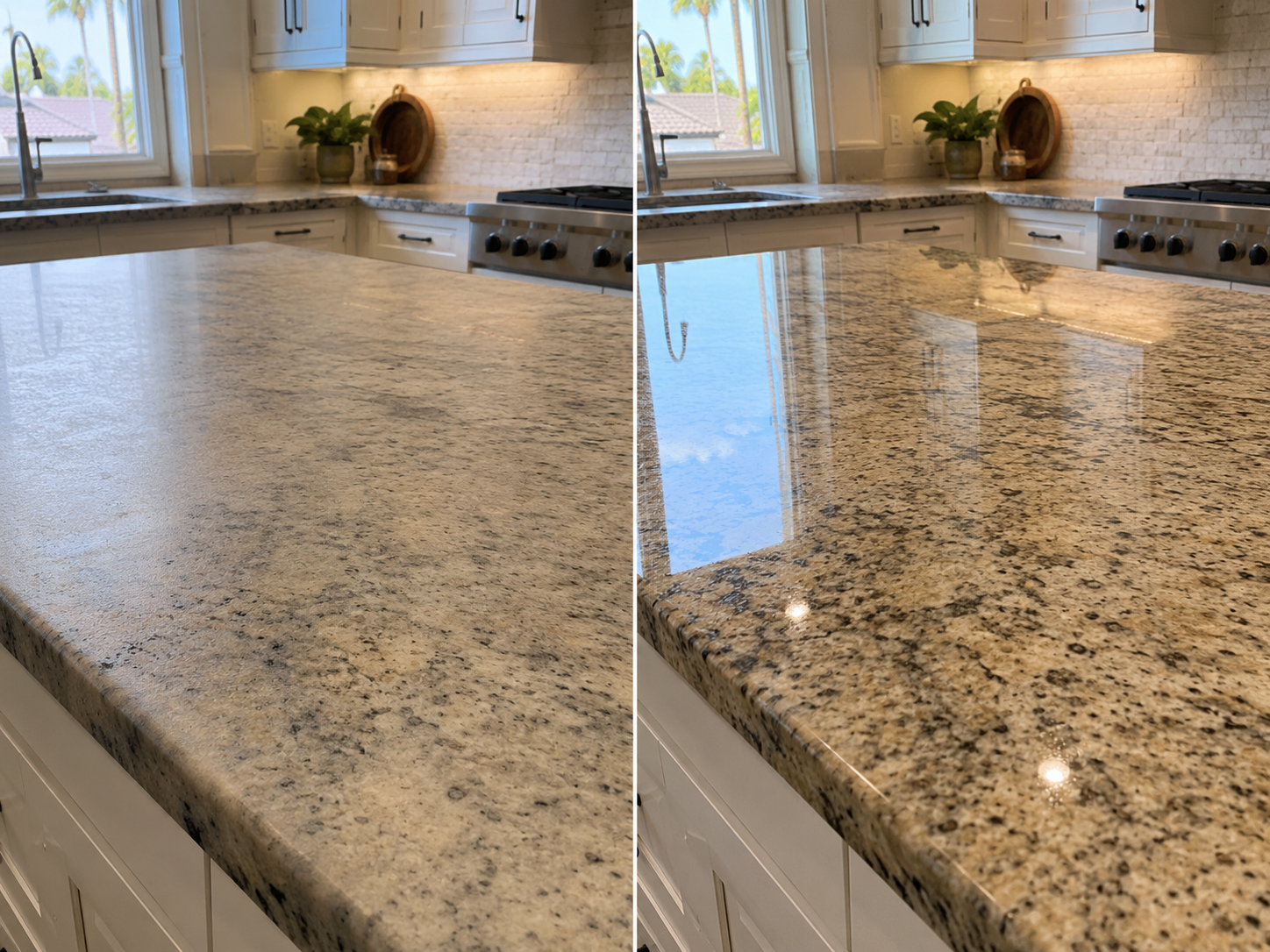
 Granite restoration is almost always the smarter first move — it typically costs 60–80% less than countertop replacement and can be completed in a single day, while full replacement is only necessary when the stone itself is structurally cracked, chipped through, or you’re changing the layout entirely. For most San Diego homeowners dealing with dull, etched, or stained granite, restoration delivers a like-new surface without the demolition, downtime, or five-figure invoice.
That said, the right answer depends on your countertop’s condition, your renovation goals, and how long you plan to stay in the home. Below, we break down exactly how each option works so you can make a confident, informed decision.
Understanding Granite Restoration
Granite restoration is a multi-step process that repairs and revives the existing stone in place, rather than removing it. A trained technician diagnoses the surface — checking for etching, dullness, hairline cracks, pitting, or failed sealant — and then works through diamond honing, polishing, crack and chip repair, and resealing to bring the slab back to its original luster.
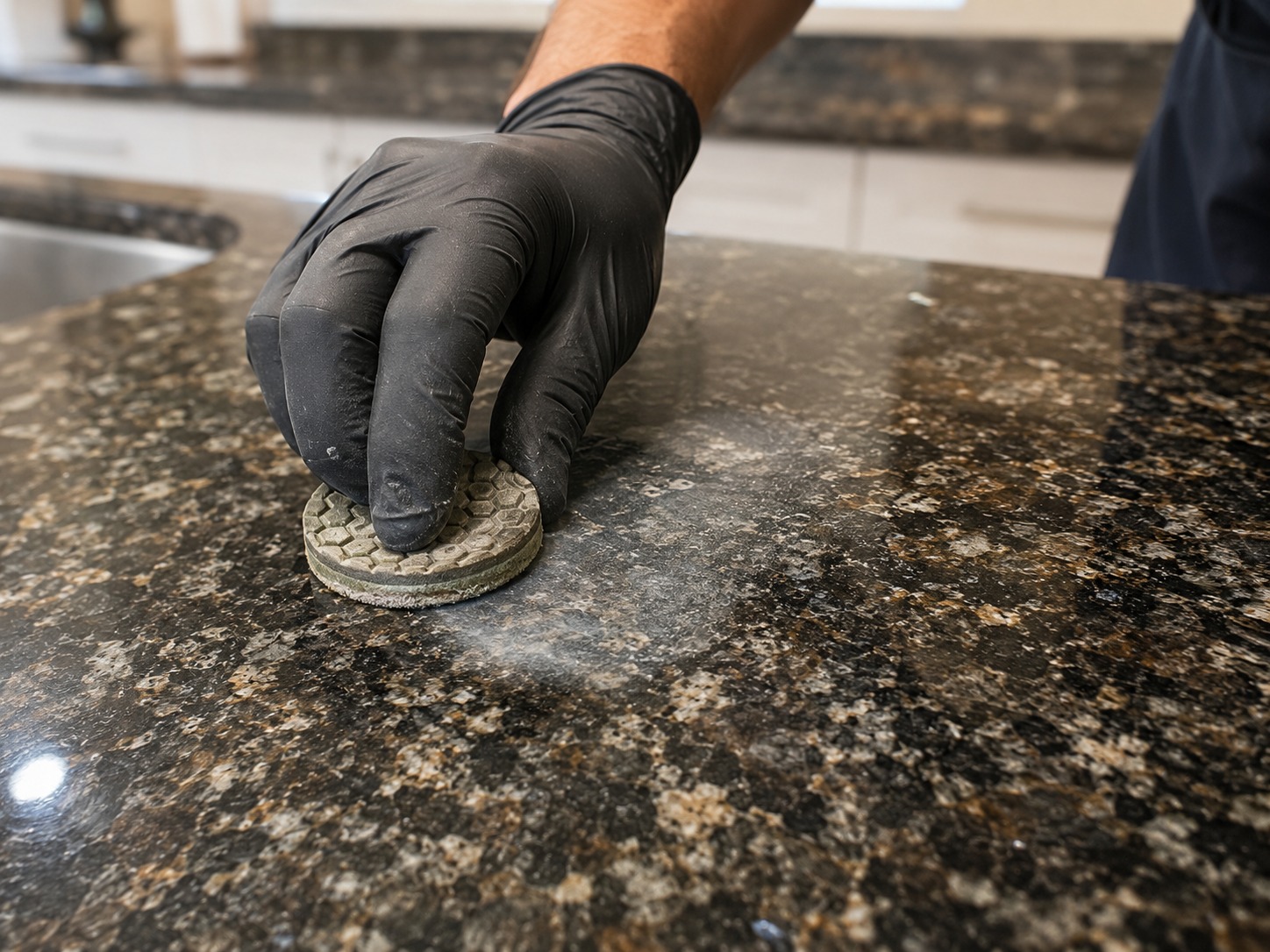 How it works: Diamond abrasive pads progressively refine the surface, removing scratches and etching. Chips are filled with color-matched epoxy, seams are re-set if they’ve separated, and a fresh penetrating sealant is applied to block moisture and bacteria from re-entering the stone’s naturally porous surface.
Typical costs: Most San Diego granite restoration jobs run between $300 and $900 for a standard kitchen, depending on square footage and the extent of damage. Full crystallization and multi-stage polishing packages can run higher, but they’re still a fraction of replacement pricing.
Core benefits: Same-day or next-day turnaround, no demolition, no plumbing disconnection, and the ability to preserve a slab that may no longer be available in the same pattern or lot. Restoration also extends the life of a countertop that’s otherwise structurally sound.
Ideal use cases: Surface-level dullness, hard water staining, minor etching from citrus or cleaning products, small chips near the sink or edges, and countertops that simply need their shine and protective seal renewed. If your granite still holds its shape and thickness, restoration is almost always worth attempting before replacement is even considered.
Understanding Countertop Replacement
Countertop replacement means removing the existing slab entirely and installing new material — whether that’s fresh granite, quartz, quartzite, or another engineered stone. This is a full renovation project involving measurement, fabrication, demolition, and reinstallation.
How it works: A fabricator templates your cabinetry, cuts new slabs (or engineered material) to size, and installs them with new seams, sink cutouts, and edge profiles. Plumbing, cooktops, and backsplashes typically need to be disconnected and reset around the new surface.
Typical costs: Countertop replacement in San Diego generally runs $2,000 to $8,000+ for a mid-size kitchen, depending on material choice, edge detailing, and whether cabinetry or plumbing modifications are required. Premium slabs and custom layouts push costs higher still.
Core benefits: A completely new surface with zero prior wear, the freedom to change color, pattern, or material entirely, and the option to reconfigure layout — adding an island, extending an overhang, or upgrading edge profiles. Replacement is the only real path forward when a slab is cracked through, badly warped, or simply doesn’t match a broader remodel vision.
Ideal use cases: Structural cracks that go through the slab, extensive water damage beneath the surface, countertops that no longer fit a redesigned kitchen footprint, or homeowners who want an entirely different look as part of a larger renovation.
Side-by-Side Comparison
| Attribute | Granite Restoration | Countertop Replacement |
|---|---|---|
| Upfront Cost | $300–$900, typical kitchen | $2,000–$8,000+ |
| Project Timeline | 1 day, sometimes same-visit | 1–3 weeks, including template, fabrication, and install |
| Disruption to Home | Minimal — kitchen usable same day | Significant — plumbing and appliance disconnection |
| Lifespan of Result | 1–3 years before re-polishing is recommended | 15–25+ years with proper care |
| Ability to Change Design | None — restores existing color and pattern | Full — new material, color, and layout |
| Environmental Impact | Low — no demolition or landfill waste | Higher — old slab disposal and new material sourcing |
| Best For | Cosmetic wear, minor chips, and dullness | Structural damage, full remodels, and redesigns |
Pros and Cons Breakdown
Pros of Granite Restoration
- Dramatically lower cost — a fraction of what replacement runs, freeing up budget for other projects.
- Fast turnaround — most San Diego homes are back in full kitchen use within a day.
- No demolition mess — no dust, no torn-out cabinetry, no disposal fees.
- Preserves original stone — ideal if your slab pattern or lot is no longer available.
Cons of Granite Restoration
- Doesn’t fix structural damage — deep cracks through the slab can’t be permanently resolved.
- Requires periodic maintenance — polish and seal typically need refreshing every 1–3 years.
- Can’t change the look — you’re restoring the existing color and pattern, not upgrading it.
Pros of Countertop Replacement
- Completely new surface — zero prior wear, stains, or etching history.
- Design flexibility — change material, color, edge profile, or layout entirely.
- Long-term durability — a properly installed slab can last decades.
Cons of Countertop Replacement
- High upfront investment — often 5–10x the cost of restoration.
- Extended disruption — kitchen may be partially unusable for days or weeks.
- Irreversible — once the old slab is removed, there’s no going back.
Which Option Is Better? The Ultimate Showdown
When you weigh cost against long-term benefit, the decision usually comes down to one question: is the damage cosmetic, or structural?
If your granite is dull, etched from acidic spills, lightly stained, or simply hasn’t been sealed in years, granite restoration is the clear winner. You’ll spend a fraction of the cost, avoid weeks of disruption, and end up with a countertop that looks — and performs — like new. This is especially true in San Diego, where coastal humidity and hard water can accelerate sealant breakdown faster than in drier inland climates, making periodic restoration a smart, proactive maintenance step rather than a one-time fix.
Countertop replacement earns its place when the stone itself is compromised — a crack running through the slab, a chip so deep it’s reached the substrate, or water damage that’s undermined the surface from below. It’s also the right call if you’re mid-remodel and want a completely different material, color, or layout as part of a broader kitchen redesign. Many San Diego homeowners renovating older mid-century or coastal properties choose replacement specifically to modernize a kitchen’s overall footprint, not just to fix wear and tear.
Choose granite restoration if: your priority is protecting your budget, minimizing downtime, and your countertop’s core structure is sound.
Choose countertop replacement if: you have cracks, structural damage, or you’re investing in a full design change and have the budget to match.
For most homeowners, the smartest approach is to start with a professional assessment. A trained technician can tell within minutes whether your granite is a restoration candidate or truly needs replacing — saving you from spending thousands on a new slab when a same-day polish would have done the job.
Get a Free Countertop Assessment in San Diego
Not sure whether your countertops need granite restoration or full countertop replacement? Our San Diego team offers no-pressure consultations to evaluate your surface and recommend the most cost-effective path forward. Whether it’s a quick diamond honing session or a full countertop restoration package, we’ll walk you through exactly what your stone needs — and what it doesn’t. Reach out today to schedule your assessment.
Conclusion & Recommendation
For the majority of San Diego homeowners, granite restoration vs countertop replacement isn’t really a close call — restoration wins on cost, speed, and convenience whenever the underlying stone is structurally sound. Replacement remains the right investment only when damage runs deep or a full design overhaul is already on the table. When in doubt, get a professional opinion before committing to either path; a five-minute inspection can save you thousands.
Frequently Asked Questions
Is granite restoration as good as replacing the countertop?
Is granite restoration as good as replacing the countertop?
For cosmetic issues like dullness, etching, and minor staining, restoration achieves a comparable visual result at a fraction of the cost. It won’t fix structural cracks, but for surface wear, most homeowners can’t tell the difference.
How much does granite restoration cost in San Diego?
How much does granite restoration cost in San Diego?
Most standard kitchen jobs range from $300 to $900, depending on square footage, the number of chips or cracks needing repair, and whether crystallization is included.
How long does granite restoration last before I need to redo it?
How long does granite restoration last before I need to redo it?
A quality restoration and reseal typically holds up for 1 to 3 years before a touch-up polish is recommended, though daily use and cleaning habits affect the timeline.
Can restoration fix a cracked granite countertop?
Can restoration fix a cracked granite countertop?
Small chips and hairline surface cracks can be filled and blended with epoxy. However, cracks running through the full thickness of the slab generally require replacement.
Is countertop replacement worth it for an older San Diego home?
Is countertop replacement worth it for an older San Diego home?
It can be, especially if you’re modernizing the kitchen layout or the existing slab has structural damage. If the goal is purely cosmetic refresh, restoration is usually the more cost-effective first step.
How long does a full countertop replacement take?
How long does a full countertop replacement take?
From initial template to final installation, most San Diego projects take one to three weeks, depending on material availability and whether cabinetry adjustments are needed.
Does granite restoration include resealing?
Does granite restoration include resealing?
Yes — professional restoration always includes a fresh penetrating sealant application as the final step, which protects the stone from moisture and bacteria going forward.
What’s the environmental difference between the two options?
What’s the environmental difference between the two options?
Restoration produces far less waste since no material is removed or discarded. Replacement involves disposing of the old slab and sourcing new stone, giving restoration a smaller environmental footprint.
Granite restoration is almost always the smarter first move — it typically costs 60–80% less than countertop replacement and can be completed in a single day, while full replacement is only necessary when the stone itself is structurally cracked, chipped through, or you’re changing the layout entirely. For most San Diego homeowners dealing with dull, etched, or stained granite, restoration delivers a like-new surface without the demolition, downtime, or five-figure invoice.
That said, the right answer depends on your countertop’s condition, your renovation goals, and how long you plan to stay in the home. Below, we break down exactly how each option works so you can make a confident, informed decision.
Understanding Granite Restoration
Granite restoration is a multi-step process that repairs and revives the existing stone in place, rather than removing it. A trained technician diagnoses the surface — checking for etching, dullness, hairline cracks, pitting, or failed sealant — and then works through diamond honing, polishing, crack and chip repair, and resealing to bring the slab back to its original luster.
How it works: Diamond abrasive pads progressively refine the surface, removing scratches and etching. Chips are filled with color-matched epoxy, seams are re-set if they’ve separated, and a fresh penetrating sealant is applied to block moisture and bacteria from re-entering the stone’s naturally porous surface.
Typical costs: Most San Diego granite restoration jobs run between $300 and $900 for a standard kitchen, depending on square footage and the extent of damage. Full crystallization and multi-stage polishing packages can run higher, but they’re still a fraction of replacement pricing.
Core benefits: Same-day or next-day turnaround, no demolition, no plumbing disconnection, and the ability to preserve a slab that may no longer be available in the same pattern or lot. Restoration also extends the life of a countertop that’s otherwise structurally sound.
Ideal use cases: Surface-level dullness, hard water staining, minor etching from citrus or cleaning products, small chips near the sink or edges, and countertops that simply need their shine and protective seal renewed. If your granite still holds its shape and thickness, restoration is almost always worth attempting before replacement is even considered.
Understanding Countertop Replacement
Countertop replacement means removing the existing slab entirely and installing new material — whether that’s fresh granite, quartz, quartzite, or another engineered stone. This is a full renovation project involving measurement, fabrication, demolition, and reinstallation.
How it works: A fabricator templates your cabinetry, cuts new slabs (or engineered material) to size, and installs them with new seams, sink cutouts, and edge profiles. Plumbing, cooktops, and backsplashes typically need to be disconnected and reset around the new surface.
Typical costs: Countertop replacement in San Diego generally runs $2,000 to $8,000+ for a mid-size kitchen, depending on material choice, edge detailing, and whether cabinetry or plumbing modifications are required. Premium slabs and custom layouts push costs higher still.
Core benefits: A completely new surface with zero prior wear, the freedom to change color, pattern, or material entirely, and the option to reconfigure layout — adding an island, extending an overhang, or upgrading edge profiles. Replacement is the only real path forward when a slab is cracked through, badly warped, or simply doesn’t match a broader remodel vision.
Ideal use cases: Structural cracks that go through the slab, extensive water damage beneath the surface, countertops that no longer fit a redesigned kitchen footprint, or homeowners who want an entirely different look as part of a larger renovation.
Side-by-Side Comparison
| Attribute | Granite Restoration | Countertop Replacement |
|---|---|---|
| Upfront Cost | $300–$900, typical kitchen | $2,000–$8,000+ |
| Project Timeline | 1 day, sometimes same-visit | 1–3 weeks, including template, fabrication, and install |
| Disruption to Home | Minimal — kitchen usable same day | Significant — plumbing and appliance disconnection |
| Lifespan of Result | 1–3 years before re-polishing is recommended | 15–25+ years with proper care |
| Ability to Change Design | None — restores existing color and pattern | Full — new material, color, and layout |
| Environmental Impact | Low — no demolition or landfill waste | Higher — old slab disposal and new material sourcing |
| Best For | Cosmetic wear, minor chips, and dullness | Structural damage, full remodels, and redesigns |
Pros and Cons Breakdown
Pros of Granite Restoration
- Dramatically lower cost — a fraction of what replacement runs, freeing up budget for other projects.
- Fast turnaround — most San Diego homes are back in full kitchen use within a day.
- No demolition mess — no dust, no torn-out cabinetry, no disposal fees.
- Preserves original stone — ideal if your slab pattern or lot is no longer available.
Cons of Granite Restoration
- Doesn’t fix structural damage — deep cracks through the slab can’t be permanently resolved.
- Requires periodic maintenance — polish and seal typically need refreshing every 1–3 years.
- Can’t change the look — you’re restoring the existing color and pattern, not upgrading it.
Pros of Countertop Replacement
- Completely new surface — zero prior wear, stains, or etching history.
- Design flexibility — change material, color, edge profile, or layout entirely.
- Long-term durability — a properly installed slab can last decades.
Cons of Countertop Replacement
- High upfront investment — often 5–10x the cost of restoration.
- Extended disruption — kitchen may be partially unusable for days or weeks.
- Irreversible — once the old slab is removed, there’s no going back.
Which Option Is Better? The Ultimate Showdown
When you weigh cost against long-term benefit, the decision usually comes down to one question: is the damage cosmetic, or structural?
If your granite is dull, etched from acidic spills, lightly stained, or simply hasn’t been sealed in years, granite restoration is the clear winner. You’ll spend a fraction of the cost, avoid weeks of disruption, and end up with a countertop that looks — and performs — like new. This is especially true in San Diego, where coastal humidity and hard water can accelerate sealant breakdown faster than in drier inland climates, making periodic restoration a smart, proactive maintenance step rather than a one-time fix.
Countertop replacement earns its place when the stone itself is compromised — a crack running through the slab, a chip so deep it’s reached the substrate, or water damage that’s undermined the surface from below. It’s also the right call if you’re mid-remodel and want a completely different material, color, or layout as part of a broader kitchen redesign. Many San Diego homeowners renovating older mid-century or coastal properties choose replacement specifically to modernize a kitchen’s overall footprint, not just to fix wear and tear.
Choose granite restoration if: your priority is protecting your budget, minimizing downtime, and your countertop’s core structure is sound.
Choose countertop replacement if: you have cracks, structural damage, or you’re investing in a full design change and have the budget to match.
For most homeowners, the smartest approach is to start with a professional assessment. A trained technician can tell within minutes whether your granite is a restoration candidate or truly needs replacing — saving you from spending thousands on a new slab when a same-day polish would have done the job.
Get a Free Countertop Assessment in San Diego
Not sure whether your countertops need granite restoration or full countertop replacement? Our San Diego team offers no-pressure consultations to evaluate your surface and recommend the most cost-effective path forward. Whether it’s a quick diamond honing session or a full countertop restoration package, we’ll walk you through exactly what your stone needs — and what it doesn’t. Reach out today to schedule your assessment.
Conclusion & Recommendation
For the majority of San Diego homeowners, granite restoration vs countertop replacement isn’t really a close call — restoration wins on cost, speed, and convenience whenever the underlying stone is structurally sound. Replacement remains the right investment only when damage runs deep or a full design overhaul is already on the table. When in doubt, get a professional opinion before committing to either path; a five-minute inspection can save you thousands.
Frequently Asked Questions
Is granite restoration as good as replacing the countertop?
Is granite restoration as good as replacing the countertop?
For cosmetic issues like dullness, etching, and minor staining, restoration achieves a comparable visual result at a fraction of the cost. It won’t fix structural cracks, but for surface wear, most homeowners can’t tell the difference.
How much does granite restoration cost in San Diego?
How much does granite restoration cost in San Diego?
Most standard kitchen jobs range from $300 to $900, depending on square footage, the number of chips or cracks needing repair, and whether crystallization is included.
How long does granite restoration last before I need to redo it?
How long does granite restoration last before I need to redo it?
A quality restoration and reseal typically holds up for 1 to 3 years before a touch-up polish is recommended, though daily use and cleaning habits affect the timeline.
Can restoration fix a cracked granite countertop?
Can restoration fix a cracked granite countertop?
Small chips and hairline surface cracks can be filled and blended with epoxy. However, cracks running through the full thickness of the slab generally require replacement.
Is countertop replacement worth it for an older San Diego home?
Is countertop replacement worth it for an older San Diego home?
It can be, especially if you’re modernizing the kitchen layout or the existing slab has structural damage. If the goal is purely cosmetic refresh, restoration is usually the more cost-effective first step.
How long does a full countertop replacement take?
How long does a full countertop replacement take?
From initial template to final installation, most San Diego projects take one to three weeks, depending on material availability and whether cabinetry adjustments are needed.
Does granite restoration include resealing?
Does granite restoration include resealing?
Yes — professional restoration always includes a fresh penetrating sealant application as the final step, which protects the stone from moisture and bacteria going forward.
What’s the environmental difference between the two options?
What’s the environmental difference between the two options?
Restoration produces far less waste since no material is removed or discarded. Replacement involves disposing of the old slab and sourcing new stone, giving restoration a smaller environmental footprint.


