
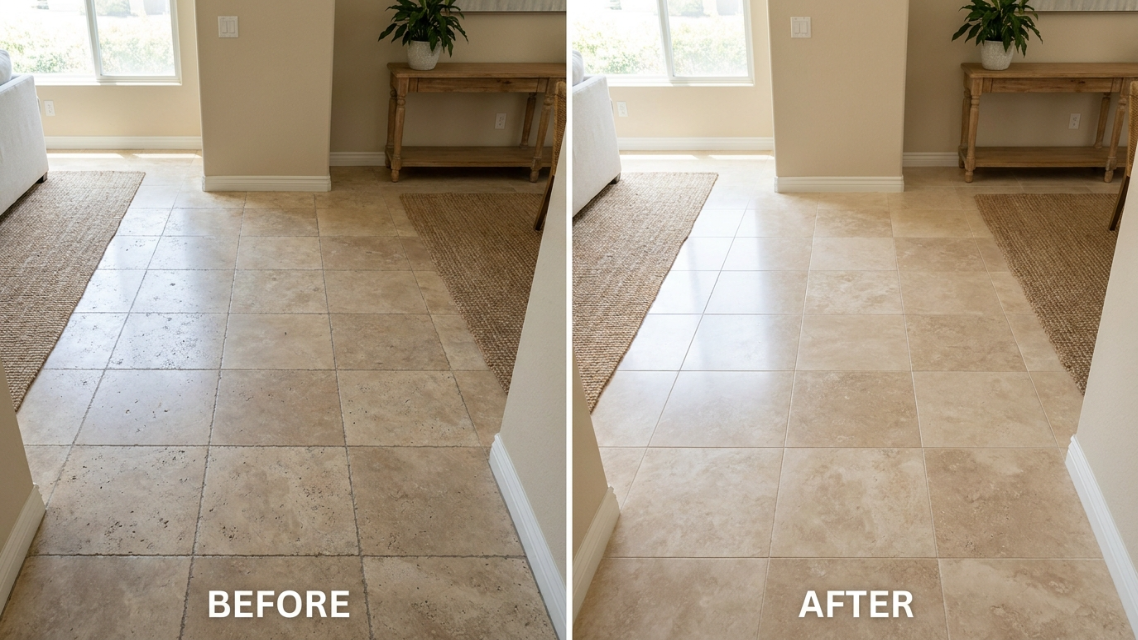
 In most cases, professional travertine cleaning costs 70-90% less than full replacement, making restoration the smarter first move for anything short of structurally cracked or heaved stone. Homeowners across San Diego often assume dull, stained, or pitted travertine means it’s time to tear it out — but the honeycomb-textured stone is remarkably restorable. Before you call a contractor for demolition, it’s worth understanding exactly how travertine cleaning cost vs replacement cost stacks up, because the financial and disruption gap between the two is enormous. This guide breaks down both paths so you can decide with confidence.
Understanding Travertine Cleaning
Professional travertine cleaning is a multi-step restoration process, not a simple mop-and-go service. Technicians typically start with a deep extraction clean to lift embedded soil from the stone’s naturally porous pits, follow with honing to level out scratches and etching, then polish and reseal the surface to restore its shine and protect it from future staining. For homes with the classic filled-and-honed travertine common in San Diego’s Spanish Revival and Mediterranean-style properties, this process can also include re-filling worn holes with matching epoxy or grout to smooth the surface.
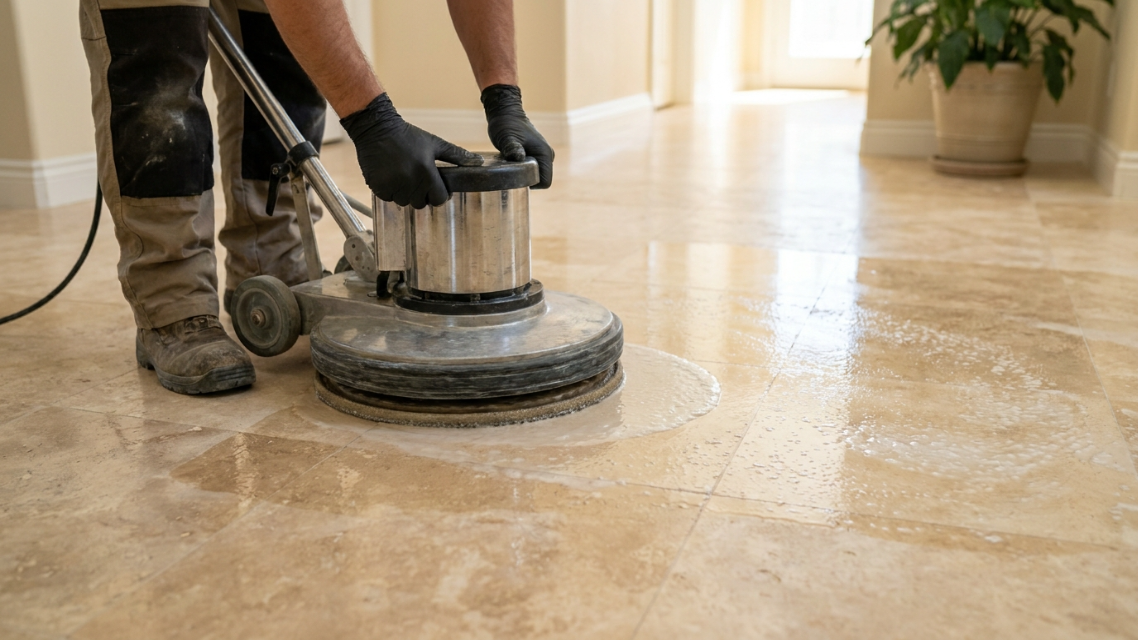 Typical travertine cleaning cost in the San Diego area ranges from $2 to $8 per square foot, depending on the size of the space, the condition of the stone, and whether repairs like chip and crack repair or stone crystallization are needed. A standard 400-square-foot living area might run $800 to $3,200 for full deep cleaning, honing, and sealing — a fraction of what tearing out and replacing the same floor would cost.
Core benefits of cleaning include same-day or next-day turnaround, minimal disruption to your household, no demolition debris, and the ability to preserve original architectural stonework that’s often irreplaceable in older San Diego homes. It’s ideal for travertine that’s dull, stained, lightly scratched, or suffering from mineral buildup — which describes the vast majority of aging travertine floors, patios, and countertops.
Understanding Travertine Replacement
Replacement means fully removing the existing travertine — floor, patio, or countertop — and installing new material. This involves demolition, hauling away debris, surface prep or subfloor repair, and a full reinstallation with new stone, thinset, grout, and sealer. For outdoor travertine pavers common on San Diego patios and pool decks, replacement can also require regrading and drainage adjustments to meet current standards.
Replacement costs run significantly higher: expect $15 to $30+ per square foot installed, depending on the grade of travertine, labor rates, and project complexity. That same 400-square-foot space could cost $6,000 to $12,000 or more once demolition, disposal, materials, and labor are factored in — and that’s before accounting for potential delays from permitting or material backorders.
Replacement makes sense when travertine is structurally compromised: deep cracking through the stone body, significant heaving or lippage from subfloor movement, water damage that’s undermined the substrate, or when a homeowner wants an entirely different layout, pattern, or stone variety. It’s a bigger investment, but it resets the surface completely and can increase resale value when done as part of a broader renovation.
Side-by-Side Comparison
| Attribute | Travertine Cleaning | Travertine Replacement |
|---|---|---|
| Upfront Cost | $2–$8 per sq ft | $15–$30+ per sq ft |
| Project Timeline | 1–2 days | 1–3 weeks, including demo, prep, and curing |
| Disruption Level | Low — rooms usable same day or next day | High — furniture removal, dust, noise, and access restrictions |
| Lifespan Extension | 3–5 years before re-service, with sealing | 20–30+ years with proper care |
| Best For | Dull, stained, etched, or lightly damaged stone | Cracked, heaved, or structurally failed stone |
| Environmental Impact | Minimal — no demolition waste | Higher — debris removal and new material production |
| Resale Value Impact | Restores existing value | Can boost value if paired with a design upgrade |
Pros and Cons Breakdown
Pros of Travertine Cleaning
- Dramatically lower cost — typically a small fraction of full replacement pricing
- Fast turnaround — most jobs wrap up in a day, sometimes less
- Preserves original character — keeps historic or custom-cut stone patterns intact
- Minimal household disruption — no demolition dust, no extended furniture staging
- Reversible damage fix — etching, staining, and dullness are almost always correctable
Cons of Travertine Cleaning
- Not a permanent fix for structural issues — won’t address cracked or heaved stone
- Requires periodic re-service — sealing and polishing typically need refreshing every few years
- Limited design change — you’re restoring the existing layout, not redesigning it
Pros of Travertine Replacement
- Complete reset — eliminates any underlying subfloor or drainage issues
- Design flexibility — allows a new pattern, stone grade, or finish
- Longest lifespan — properly installed new stone can last decades
- Addresses root causes — fixes cracking or heaving tied to structural movement
Cons of Travertine Replacement
- High upfront investment — often 3-5x the cost of professional cleaning
- Significant disruption — weeks without full use of the space
- Demolition waste — more material sent to landfill
- Risk of matching issues — new stone batches can vary slightly from existing surrounding areas
Which Option Is Better? The Ultimate Showdown
When weighing travertine cleaning cost vs replacement cost, the decision usually comes down to the condition of the stone rather than personal preference. If your travertine is dull, stained, mildly etched from acidic spills, or simply looking tired after years of San Diego’s coastal humidity and UV exposure, cleaning wins decisively — you’ll spend a fraction of the money, avoid weeks of disruption, and get results that look nearly new.
Choose cleaning if: your stone is intact but worn, you’re on a budget, you want a fast turnaround, or you’re preparing a home for sale and need a quick visual refresh without a full renovation timeline.
Choose replacement if: the stone has structural cracks running through the tile body, sections have heaved or shifted due to subfloor movement, water intrusion has damaged the substrate beneath the travertine, you’re dealing with failing countertop seams, or you’re already planning a broader remodel and want a different stone pattern or layout.
For most San Diego homeowners — especially those with the original travertine common in homes built during the region’s mid-century and Spanish Revival building booms — cleaning and restoration deliver the better return on investment. If you’re taking the DIY-adjacent research route first, our step-by-step travertine care guide covers the basics, though professional service is recommended for anything beyond light upkeep. Replacement should be reserved for stone that’s genuinely beyond saving, not simply outdated in appearance.
Get a Free Travertine Consultation in San Diego
If you’re still weighing travertine cleaning cost vs replacement cost for your own home, the fastest way to get clarity is a free, no-pressure evaluation. Our team can assess whether your San Diego travertine floors, patios, or countertops are strong candidates for restoration — and give you an honest recommendation, even if that means telling you cleaning is all you need. Visit our Travertine Cleaning service page to request your consultation today.
Conclusion & Recommendation
For the vast majority of homeowners, professional cleaning is the clear winner in the travertine cleaning cost vs replacement cost comparison — it costs less, takes far less time, and preserves the character of stone that’s often difficult to replicate. Replacement still has its place, but it should be reserved for travertine with genuine structural failure rather than surface-level wear. When in doubt, a professional assessment is the best first step before committing to either path.
Frequently Asked Questions
Is it cheaper to clean travertine or replace it?
Is it cheaper to clean travertine or replace it?
Cleaning is almost always cheaper, typically costing 70-90% less than full replacement when the stone itself is structurally sound.
How much does professional travertine cleaning cost in San Diego?
How much does professional travertine cleaning cost in San Diego?
Most San Diego homes pay between $2 and $8 per square foot for deep cleaning, honing, and sealing, depending on the size and condition of the area.
How much does travertine replacement cost?
How much does travertine replacement cost?
Full replacement, including demolition and new material installation, typically runs $15 to $30 or more per square foot.
Can cracked travertine be cleaned instead of replaced?
Can cracked travertine be cleaned instead of replaced?
Minor surface cracks and chips can often be repaired and blended during cleaning, but deep structural cracks through the stone usually require replacement.
How long does travertine cleaning last before it needs to be redone?
How long does travertine cleaning last before it needs to be redone?
With proper sealing, a professional clean and polish typically lasts 3 to 5 years before another service is needed.
Does San Diego’s climate affect travertine maintenance?
Does San Diego’s climate affect travertine maintenance?
Yes — coastal humidity, salt air near the water, and strong UV exposure can accelerate staining and sealer breakdown, making periodic professional cleaning especially valuable here.
Is travertine replacement worth it for a home resale?
Is travertine replacement worth it for a home resale?
It can be, especially if paired with a broader design update, but a professional cleaning is often enough to boost resale appeal at a much lower cost.
How do I know if my travertine needs cleaning or replacement?
How do I know if my travertine needs cleaning or replacement?
A professional inspection is the best way to tell — surface dullness, staining, and light etching point to cleaning, while structural cracking or heaving points to replacement.
Can outdoor travertine patios be cleaned the same way as indoor floors?
Can outdoor travertine patios be cleaned the same way as indoor floors?
Yes, though outdoor travertine often needs additional attention to grout lines, drainage, and weather-resistant sealing given San Diego’s sun and occasional rain exposure.
What’s included in a professional travertine cleaning service?
What’s included in a professional travertine cleaning service?
A typical service includes deep extraction cleaning, honing to remove scratches and etching, hole-filling if needed, polishing, and sealing.


