
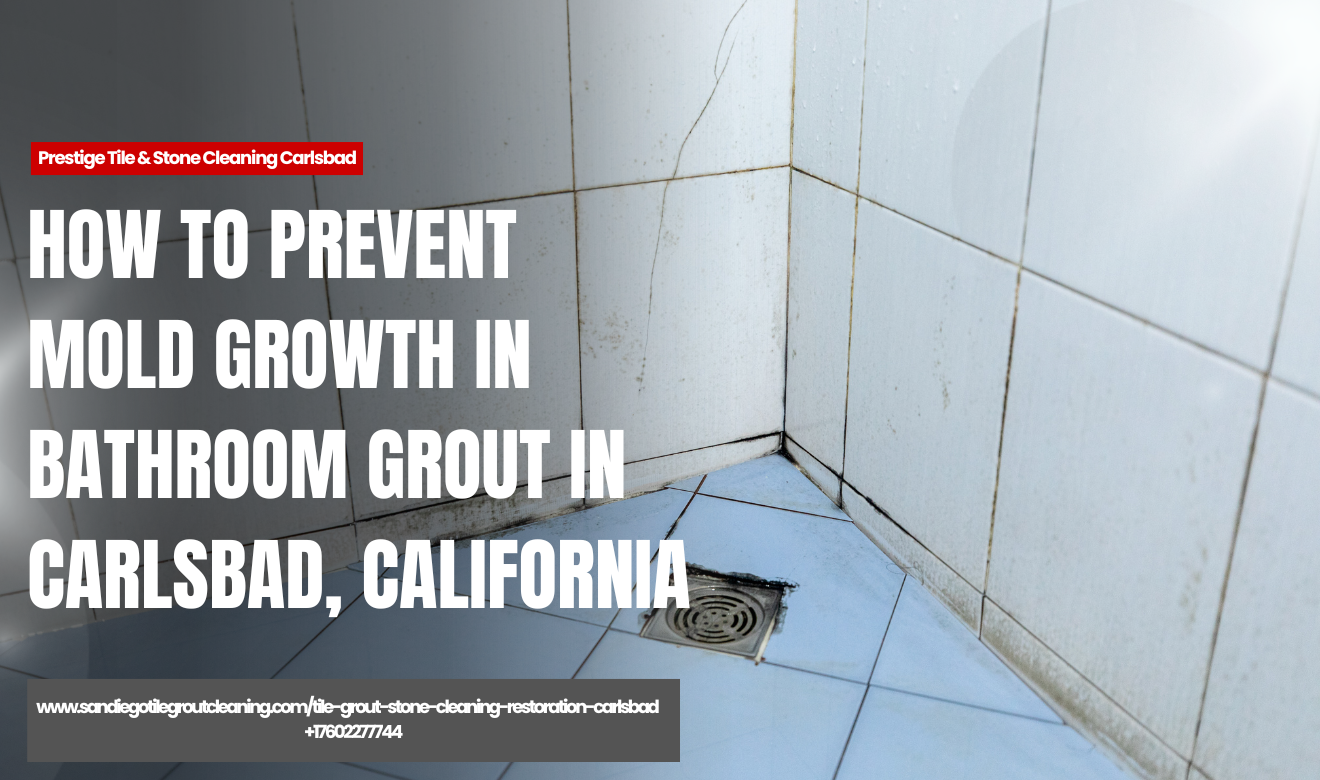
Executive Summary
Mold spreads quickly in Carlsbad bathroom grout because porous grout holds moisture after showers, coastal humidity slows drying, and soap scum/body oils provide nutrients. The most reliable prevention is reducing “wet time” through ventilation, daily drying habits, routine cleaning, and fixing caulk or moisture intrusion points.
Key Takeaways
- Moisture + residue drives rapid regrowth — Warm shower steam soaks into grout and combines with soap scum and skin oils, creating ideal conditions for mold to colonize and return quickly.
- Ventilation is the make-or-break control — Running an effective exhaust fan during and 20–30 minutes after showers (and ensuring it vents outdoors) dramatically reduces lingering humidity that fuels mold.
- Short daily drying routines prevent most problems — Squeegeeing tile/glass and towel-wiping corners and the bottom grout line removes water before it wicks into grout where spotting typically begins.
- Sealing helps, but it’s not a standalone fix — Grout sealer can slow absorption and staining, but mold can still return if moisture remains high or water sits on grout regularly.
- Persistent black staining often signals trapped moisture or failed caulk — When stains don’t respond well to cleaning or return fast, addressing caulk gaps, leaks, or potential behind-tile moisture (sometimes via professional deep cleaning) is key to stopping recurrence.
To prevent mold in bathroom grout in Carlsbad, California, keep the grout as dry as possible, improve ventilation, and clean it regularly before dark spots take hold. Understanding how mold grows in bathroom grout Carlsbad homes often comes down to the same pattern: warm showers create moisture, that moisture lingers in porous grout, and mold feeds on soap scum and skin oils left behind.
For example, if your bathroom mirror stays foggy for 20 minutes after a shower, your grout is likely staying damp long enough for mold to spread. If water beads along the shower corners or sits on the tub ledge, it can wick into grout lines and start discoloration within days. Simple habits like running the exhaust fan during and after showers, squeegeeing tile walls, and wiping down the grout near the floor can dramatically slow mold growth.
What causes mold to spread in grout so fast in coastal Carlsbad bathrooms?
If you’ve been searching for how mold grows in bathroom grout Carlsbad homes, the short version is: grout stays damp longer than you think, and damp + residue + warmth creates an ideal growth cycle. Carlsbad’s coastal air can also slow drying time, especially in interior bathrooms with no windows.
Here’s what typically speeds up how mold grows in bathroom grout Carlsbad showers and tub surrounds:
- Porous grout that absorbs moisture like a sponge (especially older cement-based grout).
- Soap scum and body oils that stick to grout and tile edges—food for microbes.
- Long drying times due to weak exhaust fans, closed doors, or cool coastal humidity.
- Silicone/caulk failure that lets water slip behind tile and stay trapped.
- Daily shower use without post-shower drying (fans, squeegee, towel wipe).
How mold grows in bathroom grout Carlsbad: the 4-step cycle
Understanding how mold grows in bathroom grout Carlsbad bathrooms comes down to a repeatable sequence. If you interrupt any step, you slow or stop the problem.
- Moisture loads the surface: Steam condenses on tile, then runs into grout lines and corners.
- Grout absorbs and holds water: Grout isn’t waterproof by default. Even sealed grout can still get damp over time if the sealer is worn.
- Nutrients build up: Soap scum is largely made of fatty acids and mineral deposits; add shampoo residue and skin oils and you get a film mold can colonize.
- Colonies expand: Dark spotting often begins in corners, at the tub line, or near the shower floor where water sits longest.
That cycle is the backbone of how mold grows in bathroom grout Carlsbad properties—especially in showers used daily or multiple times per day.
What’s the difference between mold, mildew, and “just dirt” in grout?
People often Google how mold grows in bathroom grout Carlsbad after seeing black or brown staining, but grout discoloration can come from multiple sources.
- Mildew: Often appears as a surface-level gray/black film, commonly in damp bathrooms. It’s usually easier to remove early.
- Mold: Can root deeper into porous grout, especially when moisture is persistent or trapped.
- Dirt/soil staining: Looks darker where foot traffic or rinse water carries grime; tends to lighten with alkaline cleaning.
- Mineral scale: Hard, crusty buildup (white/gray) from hard water; may coexist with microbial growth.
If scrubbing removes the mark quickly and it returns within days, that pattern strongly supports how mold grows in bathroom grout Carlsbad conditions—moisture is lingering long enough for regrowth.
How to stop mold growth with daily and weekly habits (fast wins)
If you want to prevent how mold grows in bathroom grout Carlsbad showers, the most effective strategy is reducing time-on-surface moisture. Think “dry the bathroom faster.”
Daily (2–3 minutes total)
- Run the exhaust fan during the shower and for 20–30 minutes after. If your fan is weak or noisy, it’s often underperforming.
- Squeegee walls and glass to remove the water film before it wicks into grout.
- Wipe the bottom row of tile and corners with a towel—this is where how mold grows in bathroom grout Carlsbad usually starts.
- Leave the shower door/curtain open so airflow reaches wet surfaces.
Weekly (10–15 minutes)
- Clean soap scum before it hardens. The less residue, the less fuel behind how mold grows in bathroom grout Carlsbad bathrooms.
- Target corners and the tub line where water sits.
- Rinse thoroughly after cleaning—leftover product can attract soil and trap moisture.
What cleaners work best on grout (and what to avoid)
Choosing the right product matters because grout is porous and tile finishes vary. One reason how mold grows in bathroom grout Carlsbad homes gets worse is that harsh or wrong chemicals can damage grout, strip sealers, or etch stone—making surfaces more absorbent.
| Situation | Best approach | Avoid |
|---|---|---|
| Light surface spotting in shower grout | Gentle bathroom cleaner + nylon brush; dry after | Over-scrubbing with metal brushes (can damage grout) |
| Soap scum film on tile and grout edges | Cleaner designed for soap scum; rinse well | Mixing chemicals (especially bleach + acids) |
| Recurring mold-like staining in corners | Improve drying + address caulk gaps; deep clean | Ignoring failed caulk (lets water stay trapped) |
| Natural stone tile (marble, travertine, limestone) | Stone-safe, pH-neutral cleaner | Vinegar or acidic cleaners (can etch stone) |
Safety note: Never mix bleach with acids (like vinegar) or ammonia. That can create dangerous fumes. If you’re unsure, use one product at a time and rinse thoroughly.
Why ventilation is the make-or-break factor for grout in Carlsbad
Ventilation is often the hidden driver behind how mold grows in bathroom grout Carlsbad homes. The U.S. Environmental Protection Agency (EPA) emphasizes that mold control starts with moisture control—if moisture remains, mold can return even after cleaning.
Practical ventilation upgrades that help break how mold grows in bathroom grout Carlsbad cycles:
- Verify the fan actually vents outdoors (not into an attic or crawlspace).
- Use a timer switch so the fan runs long enough after showers.
- Keep the door cracked to provide make-up air, especially in tightly sealed homes.
- Fix drafts and cold spots where condensation forms repeatedly on tile.
Real-world clue: if towels take a long time to dry in that bathroom, it’s reinforcing how mold grows in bathroom grout Carlsbad conditions.
How sealing grout helps (and when it doesn’t)
Sealing can slow staining and reduce water absorption, but it’s not a magic shield. If water is constantly sitting on grout, how mold grows in bathroom grout Carlsbad bathrooms can still happen—just more slowly.
Sealing is most effective when paired with:
- Consistent post-shower drying (fan + squeegee)
- Regular removal of soap scum (less microbial “food”)
- Maintained caulk lines so water doesn’t get behind tile
If your grout darkens when wet and stays dark for a long time, it may be time to evaluate whether the sealer has worn off—another reason how mold grows in bathroom grout Carlsbad shower grout seems to “come back.”
What to do when grout is already black: a step-by-step reset
Once you see deep discoloration, you’re no longer just preventing how mold grows in bathroom grout Carlsbad bathrooms—you’re correcting conditions that have existed for a while.
Step 1: Remove the moisture source
- Repair leaks, dripping showerheads, and loose trim plates.
- Replace failing caulk at the tub line and corners if it’s separated or peeling.
Step 2: Deep clean to remove soap scum first
Mold removers often underperform when soap scum is thick. Get the film off so disinfecting steps can contact the surface.
Step 3: Treat staining carefully (surface vs. absorbed)
- If the stain lightens quickly: it’s likely surface growth—improve drying to stop how mold grows in bathroom grout Carlsbad recurrence.
- If it barely changes: it may be embedded staining, old pigment, or moisture trapped behind tile.
Step 4: Improve your “dry time” immediately
The biggest reason people think cleaning “didn’t work” is that the bathroom returns to the same damp conditions that caused how mold grows in bathroom grout Carlsbad in the first place.
When professional cleaning is worth it (and what it typically includes)
Professional service becomes valuable when staining is extensive, grout lines are uneven or fragile, or you want restoration without trial-and-error chemicals. A professional Tile & Grout Cleaning can extract embedded soil, break down residue, and help reset the surface so your prevention steps actually hold.
It’s also worth it if you suspect moisture is traveling behind tile—one of the most stubborn causes behind how mold grows in bathroom grout Carlsbad showers.
For more guidance on keeping grout consistently clean, this walkthrough on grout cleaning lays out practical maintenance strategies that reduce recurring staining.
Cost: what homeowners usually spend to prevent repeat grout mold
Costs vary by bathroom size and condition, but prevention is usually cheaper than repeated “scrub-and-regret” cycles or repairs. Typical spending categories include:
- Ventilation improvements (fan, timer switch, ducting fixes)
- Routine cleaners and tools (squeegee, microfiber towels, nylon brushes)
- Periodic deep cleaning when staining builds up
- Re-caulking and minor repairs that stop water intrusion
If you focus on drying time and residue removal, you directly attack how mold grows in bathroom grout Carlsbad conditions and reduce how often you need heavy-duty interventions.
Why grout is uniquely vulnerable (a quick materials explanation)
Grout is the joint-filling material between tiles. Most traditional grout is cement-based and naturally porous, which is why it absorbs moisture and stains. If you want the technical background, grout is designed to fill gaps and stabilize tile—water resistance depends heavily on type, installation, and sealing.
This porosity is exactly why how mold grows in bathroom grout Carlsbad is so common: the grout holds moisture longer than the tile surface itself.
Mini case examples: what “fixed it” in real bathrooms
These are common patterns seen in residential bathrooms (and they map directly to how mold grows in bathroom grout Carlsbad scenarios):
- Case 1: Fan runtime was too short
Homeowner ran the fan only during showers. Extending runtime to 20–30 minutes after, plus leaving the shower door open, reduced recurring corner spotting. - Case 2: Soap scum drove fast regrowth
Switching to a weekly soap scum removal routine and quick daily squeegee reduced the “comes back in a week” issue typical of how mold grows in bathroom grout Carlsbad showers. - Case 3: Failed caulk line
Black staining clustered along the tub edge. Re-caulking (after proper drying) stopped water from wicking into grout lines and reduced discoloration.
“Keep It Bright” final checklist for Carlsbad grout
If you want a simple plan that prevents how mold grows in bathroom grout Carlsbad bathrooms, follow this checklist:
- Run exhaust fan during shower + 20–30 minutes after
- Squeegee walls and wipe bottom grout line daily
- Clean soap scum weekly (don’t wait for buildup)
- Inspect caulk quarterly and replace if separated
- Keep bathroom door cracked after shower for airflow
- Consider periodic deep cleaning and resealing if grout stays dark when wet
Credentials that matter when addressing persistent grout mold
When problems keep returning, the most reliable approach is applying established moisture-control and remediation principles. Guidance from organizations like the EPA aligns on the same fundamentals: control moisture, clean the residue, and prevent re-wetting. Following that framework consistently is the most dependable way to break the cycle of how mold grows in bathroom grout Carlsbad homes.
Frequently Asked Questions
Stop Grout Mold in Its Tracks—Get a Pro “Reset” in Carlsbad
If your grout keeps darkening no matter how often you scrub, it’s usually a moisture + residue problem that needs more than another store-bought spray. Prestige Tile & Stone Cleaning Carlsbad can deep-clean tile and grout, break down the soap-scum layer mold feeds on, and help you get back to a bathroom that stays brighter longer—especially in Carlsbad’s slower-drying coastal conditions.


