
Executive Summary
The white powder on exterior stone is most often efflorescence—salts transported to the surface by moisture moving through mortar, grout, concrete, or porous stone and left behind when that moisture evaporates. The definitive fix is a two-part approach: remove deposits with stone-safe, low-saturation methods and stop the moisture pathway (irrigation, drainage, caps/flashing, leaks) so the salts stop migrating back.
3 Core Insights
- Efflorescence Is a Moisture Symptom: If the residue brushes off dry and returns after rain, fog/dew, or sprinkler cycles, the problem is ongoing water movement through the assembly—not “surface dirt.”
- Cleaning Can Make It Worse If Done Wrong: Acids (muriatic/vinegar), aggressive pressure washing, or sealing over active salts can etch stone, weaken joints, and trap moisture—causing faster, heavier recurrence.
- Long-Term Control Comes From Water Management: Adjust sprinklers, correct grade/drainage, repair caps and joints, and route downspouts away so the wall can dry and salts are no longer carried to the face.
Article Text
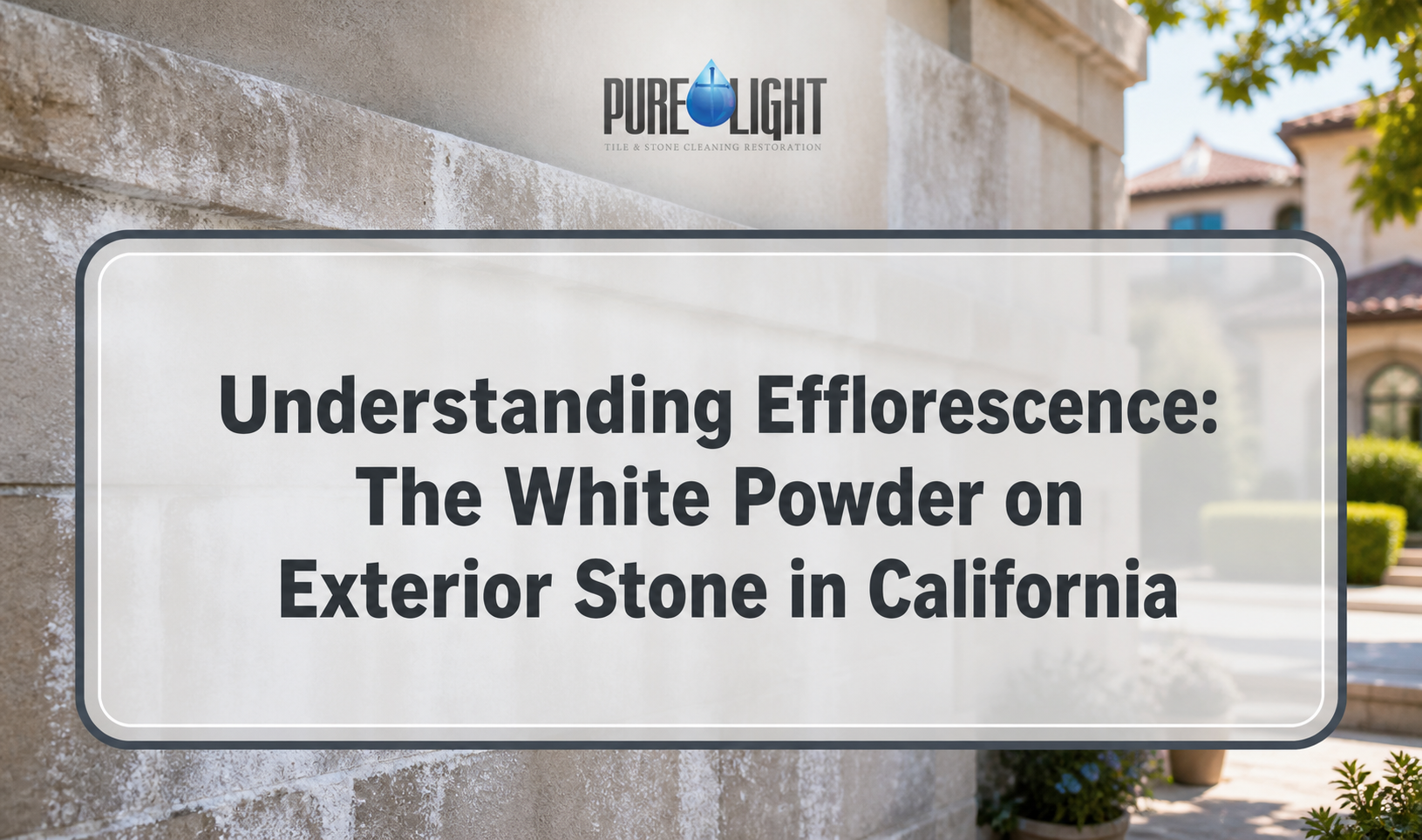
Efflorescence is a white, powdery salt deposit that forms on exterior stone when moisture moves through masonry and evaporates at the surface. Many California homeowners searching “what is this white powder on my exterior stone” are seeing mineral salts carried by water from mortar, grout, concrete backer, or the stone itself. It often shows up after winter rains in the Bay Area, coastal fog cycles along the Central Coast, or sprinkler overspray during hot inland summers. You may notice it on stacked-stone veneer, flagstone caps, retaining walls, or stone-faced fireplaces, especially at the base of walls where water wicks up. On porous stones like sandstone and some limestones, the white film can spread in a haze; on tighter stones like granite, it may collect in mortar joints and drip lines. In Northern California hillside homes, poor drainage behind retaining walls can push water through joints and leave chalky streaks at weep points. In Southern California, hard irrigation water can leave similar-looking deposits near planters, but true efflorescence is typically dry, dusty, and reappears after the next wetting and drying cycle.
What the White Powder Usually Is (and Why It Keeps Coming Back)
Efflorescence is a predictable masonry behavior: water dissolves soluble salts inside cement-based materials and deposits them as a white powder when the water evaporates at the surface. If the deposit disappears when brushed dry but returns after the next wetting/drying cycle, that pattern strongly indicates salt migration rather than surface dirt.
When rain, fog condensation, washing, or irrigation saturates stone veneer, mortar, or the wall assembly behind it, the moisture moves by capillary action through pores and microcracks. As it travels, it dissolves salts commonly present in:
- Portland-cement mortar beds, grout joints, and concrete backer
- Setting materials used behind veneer or caps
- Natural stone with inherent mineral content (some sandstones and limestones are more prone)
The “powder” is usually a mix of salts (often including calcium-based compounds) left on the exterior face once water evaporates. The key point is that the visible residue is a symptom; the cause is moisture movement through the assembly.
Efflorescence vs. Hard-Water Scale vs. Mold: How to Tell the Difference
You can separate salt deposits from other common white residues by doing a few low-risk observations before attempting cleaning chemicals. Misidentifying the deposit is how stone gets etched, discolored, or sealed-in with stains.
- Efflorescence: dry, chalky, powdery; brushes off; often reappears after rain or irrigation; commonly forms at bases of walls, weep points, and mortar joints.
- Hard-water mineral scale: often forms in arcs and drip patterns from sprinklers or spigots; can feel crusty; more localized to spray zones; may not be as powdery.
- Mildew/algae: typically darker (green/black) and thrives in shade and constant dampness; does not “dust off” like salt.
Practical field checks that do not require special tools:
- Dry-brush test: If the residue comes off as dust and the stone beneath looks normal, efflorescence is likely.
- Reappearance test: If it returns after the next wetting/drying cycle, salts are still being transported through the material.
- Location logic: White haze along the bottom course of veneer often indicates capillary wicking from slab edges, planters, or grade contact.
Why Exterior Stone in California Is Prone: Water, Salt Sources, and Wall Design
Most recurring white powder issues on exterior stone come down to three facts: California has strong wet/dry cycling, many homes have irrigation near masonry, and veneer assemblies can trap moisture. The salt is simply what becomes visible after the moisture pathway is established.
Common California-specific drivers:
- Coastal fog + morning dew: frequent light wetting without deep drying can keep salts mobilized near the surface.
- Winter rain followed by sun: rapid evaporation drives salts to the face faster, increasing visible deposits.
- Sprinkler overspray: repeated wetting concentrates minerals and keeps the wall cycling.
- Retaining wall hydrostatic pressure: inadequate drainage can force water through joints and weeps, leaving streaks.
Building-assembly realities that matter:
- Veneer needs drainage: adhered or mechanically attached stone veneer is sensitive to behind-the-stone moisture management (weather-resistive barrier, flashing, and weep details).
- Mortar and grout are salt reservoirs: cement-based materials contain soluble compounds; the more water moves through them, the more potential deposit you see.
- Breathability matters: dense coatings or incorrect sealers can trap moisture and push salts to the face or cause localized spalling.
What Not to Do: Cleaning Mistakes That Permanently Damage Stone
The fastest way to turn a removable powder into a permanent blemish is to use the wrong chemical or pressure. Exterior stone is not one material; sandstone, limestone, slate, quartzite, granite, and manufactured stone all respond differently.
Avoid these high-risk actions:
- Do not use muriatic acid on stone veneer. Hydrochloric acid can etch calcareous stone (limestone, travertine, marble), attack mortar, and create uneven “burns.”
- Do not pressure-wash aggressively. High pressure can erode soft stone, blow out joints, and force water deeper—feeding the next efflorescence cycle.
- Do not seal over active efflorescence. Trapping salts behind a sealer can lead to continued migration, whitening under the coating, or surface flaking.
- Do not use vinegar on calcium-based stones. Acid reacts with calcite and can dull or pit the surface.
If you are unsure what the stone is, treat it as acid-sensitive until identified.
Safe Step-by-Step: How Pros Remove Efflorescence Without Etching
The correct process starts dry and escalates carefully. The goal is to remove deposited salts while minimizing new water introduction and preventing residue from being driven into pores.
- Dry removal first: Use a stiff nylon brush (not metal) and vacuum or sweep up the powder. Removing dry salts reduces the amount that can re-dissolve during wet steps.
- Controlled rinse (only if needed): Lightly mist-rinse and immediately collect runoff where possible. Avoid saturating the wall.
- Stone-appropriate cleaner selection: Use a product formulated for masonry efflorescence and compatible with your stone type. Calcareous stones typically require non-acid or buffered solutions; acid-based removers may be restricted to acid-resistant stone and must be neutralized and rinsed correctly.
- Agitation and dwell control: Apply evenly, allow manufacturer-specified dwell time, agitate with a brush, and do not allow the solution to dry on the surface.
- Thorough rinse and residue check: Rinse until rinse-water no longer feels slippery and there is no visible haze when dry.
If the deposit returns quickly, cleaning alone is not the fix; you must reduce the moisture feeding the salt transport.
For surfaces that are extensive, delicate, or already stained, consider scheduling professional Exterior Stone Cleaning to avoid etching, joint washout, and “shadow” discoloration from uneven chemical action.
Moisture-Source Checklist: Stop the White Powder at the Cause
Efflorescence ends when the moisture pathway is interrupted or reduced. The most reliable long-term strategy is a site-and-assembly review, starting with water management.
Use this checklist in order (highest frequency causes first):
- Sprinklers: Re-aim heads away from stone; reduce overspray; fix broken heads; consider drip conversion near masonry.
- Grade and drainage: Keep soil and mulch from contacting veneer; slope hardscape away from walls; keep weep screeds clear.
- Downspouts and gutters: Extend discharge away from stone walls and retaining walls; repair leaks that wet one area repeatedly.
- Planters and caps: Check for failed joints and cracks that allow water into the assembly from the top.
- Retaining walls: Verify functioning drainage (gravel backfill, perforated drain line, and clear weep holes) so hydrostatic pressure does not push water through the face.
- Hose bibs and outdoor showers: Fix slow leaks that keep masonry damp.
If you see streaks emerging from specific points (weep holes, mortar voids, cap seams), treat those as directional clues to where water is traveling.
How Grout and Mortar Contribute (and Why Joints Are Often the “Hotspot”)
Mortar joints and grout lines act like highways for moisture and dissolved salts. Even when the stone face is dense, cementitious joints can stay porous and transmit water efficiently.
Key facts that explain joint-focused deposits:
- Cement-based materials contain soluble compounds that can migrate with water and crystallize at the surface.
- Joints have higher porosity than many stones, so evaporation (and salt deposition) often concentrates there.
- Microcracks and voids in joints provide pathways for water under pressure (especially on retaining walls).
If you’re diagnosing joint-related residue, it helps to understand what grout is and how it behaves in tile and stone assemblies: grout is fundamentally a joint-filling material, and its composition and porosity influence how water and salts move through the system.
HTML Data Table: Quick Identification and Response Guide
This table summarizes common white-residue scenarios on exterior stone and the most defensible next action. Use it to match the appearance and location to a likely cause and a safe response path.
| Feature / Metric | Specifications | Local Guidelines |
|---|---|---|
| Deposit texture | Powdery, chalk-like, brushes off dry (typical efflorescence) | Start with dry brushing; avoid saturating coastal veneer walls that already cycle through fog/dew. |
| Common location pattern | Base of wall, below weeps, under caps, along mortar joints | Check irrigation overspray and grade contact first; keep soil/mulch from touching stone veneer. |
| Reappearance after rain/irrigation | Returns within days to weeks if moisture source persists | Treat water entry as the primary fix (drainage, caps, flashing), then clean remaining salts. |
| Acid sensitivity risk | High for limestone/travertine/marble; variable for sandstone; lower for many granites | When stone type is unknown, avoid acidic cleaners; test in an inconspicuous spot and rinse thoroughly. |
| Most common preventable trigger | Repeated wetting from sprinklers, leaking downspouts, or planter seepage | Adjust sprinkler arcs and convert to drip near masonry; extend downspouts away from hardscape and walls. |
When Sealing Helps (and When It Makes Things Worse)
Sealers can reduce water absorption, but only when the substrate is dry and the water-entry problem is controlled. Applying a sealer to damp, salt-active masonry can trap moisture, concentrate salts, and cause whitening beneath the sealer film or surface deterioration.
Use these decision rules:
- Seal only after efflorescence is removed and the wall is dry. “Dry” means no visible darkening from moisture and no recurring powder after several wet/dry cycles.
- Choose breathable, penetrating sealers for most exterior stone so vapor can escape. Avoid non-breathable coatings unless a design professional specifies them for a particular assembly.
- Do not use sealer as a waterproofing substitute for missing caps, failed joints, poor drainage, or flashing defects.
If your deposits are heavy or persistent, treat sealing as the final step—not the first.
When the White Powder Signals a Bigger Problem
Efflorescence is often cosmetic, but in some conditions it correlates with ongoing water intrusion that can degrade masonry. The more water moving through, the more risk you have of joint weakening, freeze-thaw stress in cold microclimates, and corrosion of embedded metals (where present).
Escalate to a more thorough inspection if you observe:
- Soft or sandy mortar joints that can be scraped out easily
- Bulging veneer, hollow-sounding stones, or loose caps
- Staining that looks like rust, which can indicate metal interaction or fasteners
- Interior symptoms on the opposite side of the wall (dampness, peeling paint, odor)
In these cases, cleaning without addressing the assembly can mask the symptoms temporarily while deterioration continues underneath.
Practical Maintenance Plan for California Exteriors
A simple maintenance routine reduces recurrence by limiting water exposure and catching defects early. The goal is predictable inspection, not constant cleaning.
Suggested schedule:
- After major storms: Inspect caps, weep points, and the base of walls for new streaks; clear debris that blocks drainage.
- Quarterly (or each season): Check sprinkler arcs and repair overspray; confirm downspouts discharge away from masonry.
- Annually: Inspect joint integrity at coping/caps and around penetrations; touch up failing sealant where appropriate.
For cleaning best practices that reduce surface damage across tile and stone, reference mastering floor cleaning techniques and apply the same principle outdoors: use the least aggressive method that achieves removal, then stop.
Clear Takeaway: Identify, Remove Safely, and Eliminate the Moisture Path
That white powder on exterior stone is most often salt residue deposited by evaporating moisture moving through masonry. The reliable solution is a two-part approach: remove deposits using stone-safe methods, then correct the water source (irrigation, drainage, caps, and leaks) so the salts stop traveling to the surface.
If the residue repeatedly returns, treat it as a moisture-management issue first and a cleaning issue second. Once water intrusion is controlled, efflorescence typically shifts from a recurring frustration to an occasional, manageable maintenance item.
Frequently Asked Questions
Frequently Asked Questions
Stop the White Powder Before It Turns Into Permanent Stone Damage
That “harmless” white haze is usually a sign that moisture is actively moving through your stone and joints—meaning the problem isn’t just on the surface. And when homeowners try to fix it with the usual go-to moves (muriatic acid, vinegar, random efflorescence removers, or a pressure washer), the result can be far worse than the original powder: etched faces on limestone or travertine, washed-out mortar joints, uneven blotching, and salts that come back even stronger because the wall was saturated during cleaning.
Here’s the real operational risk: if you clean without controlling the moisture source, you’re basically “resetting” the cycle—water keeps traveling through the assembly, salts keep migrating, and the deposits keep returning. Even worse, sealing over active efflorescence can trap salts and moisture, leading to whitening under the sealer, flaking, or surface deterioration that’s expensive to reverse. What starts as a cosmetic annoyance can quickly become a recurring maintenance headache—or a hidden water-management problem that keeps spreading across your veneer, caps, and retaining walls.
Work with a local pro who understands stone type sensitivity, California wet/dry cycles, irrigation overspray patterns, and how to remove salts without feeding the next bloom. You’ll get the deposit removed safely, the moisture pathway identified, and a realistic plan to keep it from coming right back.
Efflorescence is a white, powdery salt deposit that forms on exterior stone when moisture moves through masonry and evaporates at the surface. Many California homeowners searching “what is this white powder on my exterior stone” are seeing mineral salts carried by water from mortar, grout, concrete backer, or the stone itself. It often shows up after winter rains in the Bay Area, coastal fog cycles along the Central Coast, or sprinkler overspray during hot inland summers. You may notice it on stacked-stone veneer, flagstone caps, retaining walls, or stone-faced fireplaces, especially at the base of walls where water wicks up. On porous stones like sandstone and some limestones, the white film can spread in a haze; on tighter stones like granite, it may collect in mortar joints and drip lines. In Northern California hillside homes, poor drainage behind retaining walls can push water through joints and leave chalky streaks at weep points. In Southern California, hard irrigation water can leave similar-looking deposits near planters, but true efflorescence is typically dry, dusty, and reappears after the next wetting and drying cycle.
What the White Powder Usually Is (and Why It Keeps Coming Back)
Efflorescence is a predictable masonry behavior: water dissolves soluble salts inside cement-based materials and deposits them as a white powder when the water evaporates at the surface. If the deposit disappears when brushed dry but returns after the next wetting/drying cycle, that pattern strongly indicates salt migration rather than surface dirt.
When rain, fog condensation, washing, or irrigation saturates stone veneer, mortar, or the wall assembly behind it, the moisture moves by capillary action through pores and microcracks. As it travels, it dissolves salts commonly present in:
- Portland-cement mortar beds, grout joints, and concrete backer
- Setting materials used behind veneer or caps
- Natural stone with inherent mineral content (some sandstones and limestones are more prone)
The “powder” is usually a mix of salts (often including calcium-based compounds) left on the exterior face once water evaporates. The key point is that the visible residue is a symptom; the cause is moisture movement through the assembly.
Efflorescence vs. Hard-Water Scale vs. Mold: How to Tell the Difference
You can separate salt deposits from other common white residues by doing a few low-risk observations before attempting cleaning chemicals. Misidentifying the deposit is how stone gets etched, discolored, or sealed-in with stains.
- Efflorescence: dry, chalky, powdery; brushes off; often reappears after rain or irrigation; commonly forms at bases of walls, weep points, and mortar joints.
- Hard-water mineral scale: often forms in arcs and drip patterns from sprinklers or spigots; can feel crusty; more localized to spray zones; may not be as powdery.
- Mildew/algae: typically darker (green/black) and thrives in shade and constant dampness; does not “dust off” like salt.
Practical field checks that do not require special tools:
- Dry-brush test: If the residue comes off as dust and the stone beneath looks normal, efflorescence is likely.
- Reappearance test: If it returns after the next wetting/drying cycle, salts are still being transported through the material.
- Location logic: White haze along the bottom course of veneer often indicates capillary wicking from slab edges, planters, or grade contact.
Why Exterior Stone in California Is Prone: Water, Salt Sources, and Wall Design
Most recurring white powder issues on exterior stone come down to three facts: California has strong wet/dry cycling, many homes have irrigation near masonry, and veneer assemblies can trap moisture. The salt is simply what becomes visible after the moisture pathway is established.
Common California-specific drivers:
- Coastal fog + morning dew: frequent light wetting without deep drying can keep salts mobilized near the surface.
- Winter rain followed by sun: rapid evaporation drives salts to the face faster, increasing visible deposits.
- Sprinkler overspray: repeated wetting concentrates minerals and keeps the wall cycling.
- Retaining wall hydrostatic pressure: inadequate drainage can force water through joints and weeps, leaving streaks.
Building-assembly realities that matter:
- Veneer needs drainage: adhered or mechanically attached stone veneer is sensitive to behind-the-stone moisture management (weather-resistive barrier, flashing, and weep details).
- Mortar and grout are salt reservoirs: cement-based materials contain soluble compounds; the more water moves through them, the more potential deposit you see.
- Breathability matters: dense coatings or incorrect sealers can trap moisture and push salts to the face or cause localized spalling.
What Not to Do: Cleaning Mistakes That Permanently Damage Stone
The fastest way to turn a removable powder into a permanent blemish is to use the wrong chemical or pressure. Exterior stone is not one material; sandstone, limestone, slate, quartzite, granite, and manufactured stone all respond differently.
Avoid these high-risk actions:
- Do not use muriatic acid on stone veneer. Hydrochloric acid can etch calcareous stone (limestone, travertine, marble), attack mortar, and create uneven “burns.”
- Do not pressure-wash aggressively. High pressure can erode soft stone, blow out joints, and force water deeper—feeding the next efflorescence cycle.
- Do not seal over active efflorescence. Trapping salts behind a sealer can lead to continued migration, whitening under the coating, or surface flaking.
- Do not use vinegar on calcium-based stones. Acid reacts with calcite and can dull or pit the surface.
If you are unsure what the stone is, treat it as acid-sensitive until identified.
Safe Step-by-Step: How Pros Remove Efflorescence Without Etching
The correct process starts dry and escalates carefully. The goal is to remove deposited salts while minimizing new water introduction and preventing residue from being driven into pores.
- Dry removal first: Use a stiff nylon brush (not metal) and vacuum or sweep up the powder. Removing dry salts reduces the amount that can re-dissolve during wet steps.
- Controlled rinse (only if needed): Lightly mist-rinse and immediately collect runoff where possible. Avoid saturating the wall.
- Stone-appropriate cleaner selection: Use a product formulated for masonry efflorescence and compatible with your stone type. Calcareous stones typically require non-acid or buffered solutions; acid-based removers may be restricted to acid-resistant stone and must be neutralized and rinsed correctly.
- Agitation and dwell control: Apply evenly, allow manufacturer-specified dwell time, agitate with a brush, and do not allow the solution to dry on the surface.
- Thorough rinse and residue check: Rinse until rinse-water no longer feels slippery and there is no visible haze when dry.
If the deposit returns quickly, cleaning alone is not the fix; you must reduce the moisture feeding the salt transport.
For surfaces that are extensive, delicate, or already stained, consider scheduling professional Exterior Stone Cleaning to avoid etching, joint washout, and “shadow” discoloration from uneven chemical action.
Moisture-Source Checklist: Stop the White Powder at the Cause
Efflorescence ends when the moisture pathway is interrupted or reduced. The most reliable long-term strategy is a site-and-assembly review, starting with water management.
Use this checklist in order (highest frequency causes first):
- Sprinklers: Re-aim heads away from stone; reduce overspray; fix broken heads; consider drip conversion near masonry.
- Grade and drainage: Keep soil and mulch from contacting veneer; slope hardscape away from walls; keep weep screeds clear.
- Downspouts and gutters: Extend discharge away from stone walls and retaining walls; repair leaks that wet one area repeatedly.
- Planters and caps: Check for failed joints and cracks that allow water into the assembly from the top.
- Retaining walls: Verify functioning drainage (gravel backfill, perforated drain line, and clear weep holes) so hydrostatic pressure does not push water through the face.
- Hose bibs and outdoor showers: Fix slow leaks that keep masonry damp.
If you see streaks emerging from specific points (weep holes, mortar voids, cap seams), treat those as directional clues to where water is traveling.
How Grout and Mortar Contribute (and Why Joints Are Often the “Hotspot”)
Mortar joints and grout lines act like highways for moisture and dissolved salts. Even when the stone face is dense, cementitious joints can stay porous and transmit water efficiently.
Key facts that explain joint-focused deposits:
- Cement-based materials contain soluble compounds that can migrate with water and crystallize at the surface.
- Joints have higher porosity than many stones, so evaporation (and salt deposition) often concentrates there.
- Microcracks and voids in joints provide pathways for water under pressure (especially on retaining walls).
If you’re diagnosing joint-related residue, it helps to understand what grout is and how it behaves in tile and stone assemblies: grout is fundamentally a joint-filling material, and its composition and porosity influence how water and salts move through the system.
HTML Data Table: Quick Identification and Response Guide
This table summarizes common white-residue scenarios on exterior stone and the most defensible next action. Use it to match the appearance and location to a likely cause and a safe response path.
| Feature / Metric | Specifications | Local Guidelines |
|---|---|---|
| Deposit texture | Powdery, chalk-like, brushes off dry (typical efflorescence) | Start with dry brushing; avoid saturating coastal veneer walls that already cycle through fog/dew. |
| Common location pattern | Base of wall, below weeps, under caps, along mortar joints | Check irrigation overspray and grade contact first; keep soil/mulch from touching stone veneer. |
| Reappearance after rain/irrigation | Returns within days to weeks if moisture source persists | Treat water entry as the primary fix (drainage, caps, flashing), then clean remaining salts. |
| Acid sensitivity risk | High for limestone/travertine/marble; variable for sandstone; lower for many granites | When stone type is unknown, avoid acidic cleaners; test in an inconspicuous spot and rinse thoroughly. |
| Most common preventable trigger | Repeated wetting from sprinklers, leaking downspouts, or planter seepage | Adjust sprinkler arcs and convert to drip near masonry; extend downspouts away from hardscape and walls. |
When Sealing Helps (and When It Makes Things Worse)
Sealers can reduce water absorption, but only when the substrate is dry and the water-entry problem is controlled. Applying a sealer to damp, salt-active masonry can trap moisture, concentrate salts, and cause whitening beneath the sealer film or surface deterioration.
Use these decision rules:
- Seal only after efflorescence is removed and the wall is dry. “Dry” means no visible darkening from moisture and no recurring powder after several wet/dry cycles.
- Choose breathable, penetrating sealers for most exterior stone so vapor can escape. Avoid non-breathable coatings unless a design professional specifies them for a particular assembly.
- Do not use sealer as a waterproofing substitute for missing caps, failed joints, poor drainage, or flashing defects.
If your deposits are heavy or persistent, treat sealing as the final step—not the first.
When the White Powder Signals a Bigger Problem
Efflorescence is often cosmetic, but in some conditions it correlates with ongoing water intrusion that can degrade masonry. The more water moving through, the more risk you have of joint weakening, freeze-thaw stress in cold microclimates, and corrosion of embedded metals (where present).
Escalate to a more thorough inspection if you observe:
- Soft or sandy mortar joints that can be scraped out easily
- Bulging veneer, hollow-sounding stones, or loose caps
- Staining that looks like rust, which can indicate metal interaction or fasteners
- Interior symptoms on the opposite side of the wall (dampness, peeling paint, odor)
In these cases, cleaning without addressing the assembly can mask the symptoms temporarily while deterioration continues underneath.
Practical Maintenance Plan for California Exteriors
A simple maintenance routine reduces recurrence by limiting water exposure and catching defects early. The goal is predictable inspection, not constant cleaning.
Suggested schedule:
- After major storms: Inspect caps, weep points, and the base of walls for new streaks; clear debris that blocks drainage.
- Quarterly (or each season): Check sprinkler arcs and repair overspray; confirm downspouts discharge away from masonry.
- Annually: Inspect joint integrity at coping/caps and around penetrations; touch up failing sealant where appropriate.
For cleaning best practices that reduce surface damage across tile and stone, reference mastering floor cleaning techniques and apply the same principle outdoors: use the least aggressive method that achieves removal, then stop.
Clear Takeaway: Identify, Remove Safely, and Eliminate the Moisture Path
That white powder on exterior stone is most often salt residue deposited by evaporating moisture moving through masonry. The reliable solution is a two-part approach: remove deposits using stone-safe methods, then correct the water source (irrigation, drainage, caps, and leaks) so the salts stop traveling to the surface.
If the residue repeatedly returns, treat it as a moisture-management issue first and a cleaning issue second. Once water intrusion is controlled, efflorescence typically shifts from a recurring frustration to an occasional, manageable maintenance item.
Frequently Asked Questions
Stop the White Powder Before It Turns Into Permanent Stone Damage
That “harmless” white haze is usually a sign that moisture is actively moving through your stone and joints—meaning the problem isn’t just on the surface. And when homeowners try to fix it with the usual go-to moves (muriatic acid, vinegar, random efflorescence removers, or a pressure washer), the result can be far worse than the original powder: etched faces on limestone or travertine, washed-out mortar joints, uneven blotching, and salts that come back even stronger because the wall was saturated during cleaning.
Here’s the real operational risk: if you clean without controlling the moisture source, you’re basically “resetting” the cycle—water keeps traveling through the assembly, salts keep migrating, and the deposits keep returning. Even worse, sealing over active efflorescence can trap salts and moisture, leading to whitening under the sealer, flaking, or surface deterioration that’s expensive to reverse. What starts as a cosmetic annoyance can quickly become a recurring maintenance headache—or a hidden water-management problem that keeps spreading across your veneer, caps, and retaining walls.
Work with a local pro who understands stone type sensitivity, California wet/dry cycles, irrigation overspray patterns, and how to remove salts without feeding the next bloom. You’ll get the deposit removed safely, the moisture pathway identified, and a realistic plan to keep it from coming right back.


