
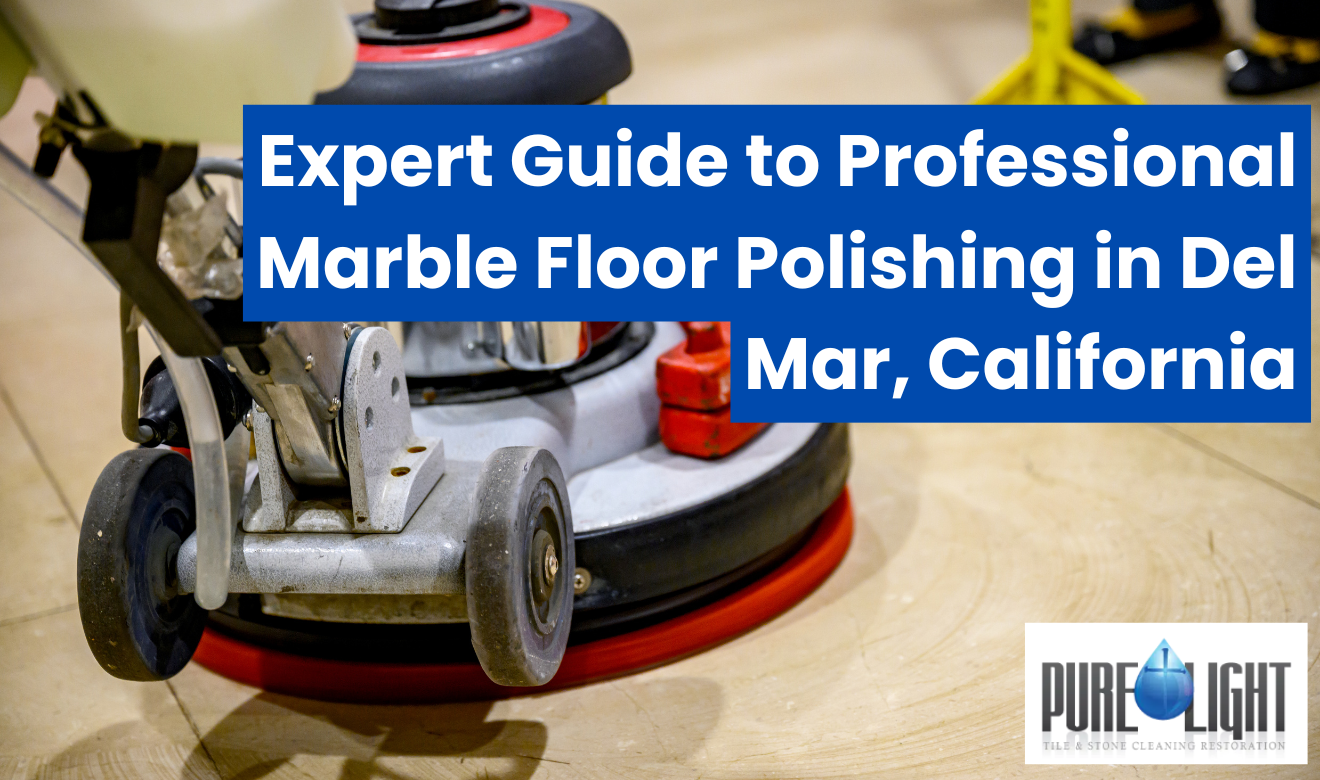
Executive Summary
Professional marble floor polishing in Del Mar restores the stone itself through measured honing and polishing—removing etches, micro-scratches, and uneven sheen rather than masking damage with topical waxes or coatings. The definitive path to long-lasting, uniform results is an inspection-led grit progression with full edge detailing and neutral-pH cleanup tailored to Del Mar’s sand-and-salt wear patterns.
3 Core Insights
- True Restoration (Not a Coating): Effective Del Mar marble polishing mechanically refines the surface to remove the damaged calcite layer from etching and wear instead of relying on shine products that haze, peel, or trap grime.
- Grit Progression Drives Uniformity: A step-by-step honing sequence (without skipped grits) is what eliminates traffic-lane haze and side-lighting defects common near entries, patio sliders, and kitchen routes.
- Edges + Aftercare Prevent “Fast Re-Dulling”: Matching field and perimeter sheen with small-diameter tooling and maintaining with neutral-pH cleaning and grit control prevents picture framing and slows the rapid coastal re-etching cycle.
Professional marble floor polishing Del Mar is the controlled mechanical refinement of marble surfaces to restore gloss, improve slip-resistance consistency, and remove etches without replacing the stone. In Del Mar homes, common problem zones include ocean-facing entries near Coast Boulevard, pool-deck thresholds, and kitchen walkways where sand grit and salt air accelerate micro-scratching. A proper service starts with a hardness and porosity check, then a grit-progression hone that targets wear patterns from chair legs, pet traffic, and rolling suitcases from vacation rentals. Etch marks from lemon, wine, or vinegar are corrected by honing past the damaged calcium carbonate layer, not by topical wax. Edges and corners are blended with smaller-diameter tooling so baseboards and tight bath vanities do not show dull “picture framing.” Final polishing uses fine powders or high-grit diamonds to match the desired sheen, from satin for wet-adjacent baths to high gloss for formal foyers, followed by neutral-pH cleaning to prevent rapid re-etching.
What “Professional Marble Floor Polishing” Means in Del Mar Homes
Professional marble polishing is a restoration process that corrects surface damage within the stone, not a coating that temporarily hides it. The goal is to re-level wear, remove etching, and bring the surface to a consistent sheen that fits how the room is used.
In coastal Del Mar, marble commonly shows a combination of:
- Micro-scratching from windblown sand, beach shoes, and gritty vacuum wheels.
- Acid etching (dull rings and “water spots”) from citrus, vinegar, wine, and many bathroom products.
- Uneven shine from spot-cleaning, entry mat borders, and traffic lanes.
- Edge dullness (“picture framing”) where prior work avoided tight areas near baseboards or vanities.
Because marble is a calcium carbonate stone, it reacts chemically with acids; correcting that damage requires controlled honing and re-polishing to remove the etched layer and re-establish the finish.
Initial Inspection: Hardness, Porosity, and Damage Mapping
A proper service starts with a quick set of field checks that determine which abrasives, chemicals, and protection steps are safe. This prevents common failures like swirl marks, over-honing soft material, or leaving etch damage beneath a shiny top layer.
Before machines touch the floor, an experienced technician typically documents:
- Stone identification (true marble vs. dolomitic marble vs. calcite-rich limestone marketed as “marble”).
- Finish type (polished, honed, or satin) and whether it was factory-finished or previously restored.
- Etch pattern locations (kitchens, wet bars, baths, pet stations).
- Scratch direction and depth (traffic lanes, chair arcs, entry paths).
- Presence of coatings (waxes, acrylic finishes, “polish” residues) that must be removed before true stone polishing.
In Del Mar properties near the coast, porosity and residue issues also show up as salt haze or airborne grime that bonds to the surface and dulls it. That is addressed by proper pre-cleaning and neutralization—not by adding more shine product.
The Grit-Progression Method: How Marble Is Actually Restored
Real marble restoration is built around abrasive refinement in steps, where each grit removes the scratches from the previous grit. Skipping steps is the most common reason floors look shiny but still show hazy traffic lanes in side lighting.
A standard approach is a controlled diamond honing progression followed by polishing. The exact grit sequence depends on the damage profile, but the process is consistent:
- Cut / correction stage: removes etches, scratches, and unevenness to a uniform “base.”
- Refinement stage: progressively reduces visible scratch pattern.
- Polish stage: brings the surface to the targeted sheen level.
- Detail stage: edges, corners, thresholds, and tight footprints are blended to match field areas.
In homes with vacation-rental turnover, technicians often focus on suitcase-wheel tracks and entry runs first, then expand out to maintain flatness and uniformity across the room.
Etch Removal vs. Stain Removal: Two Different Problems
Etching is chemical damage to the stone surface; staining is discoloration within pores. Treating one like the other leads to wasted time and inconsistent results.
- Etch marks feel smooth and look dull or chalky. They are corrected by honing/polishing (abrasive restoration).
- Stains change the color of the stone and may not change the texture. They are addressed with targeted stain-removal methods before final polishing.
If your marble has both, the sequence matters: stain treatment is typically performed first (or between honing steps, depending on chemistry), then the surface is refined and polished so the final appearance is even under natural light and overhead LEDs.
For related surface correction on stone and tile, Tile Polishing & Stain Removal is often used alongside marble work when mixed surfaces meet at thresholds or when adjacent materials need a consistent finish level.
Edges, Corners, and “Picture Framing” Control
Edges and corners must be polished with the same refinement level as the main field or the room will show a dull border. The fix is not “more powder,” but the correct tooling size and consistent grit progression into tight areas.
Del Mar bathrooms and kitchen toe-kicks often create access challenges. Professional work addresses:
- Baseboard lines using smaller diameter diamonds to match the field sheen.
- Vanity and toilet footprints where prior work may have stopped short.
- Sliding door thresholds (common near patios and pool decks) where grit and moisture concentrate.
- Transitions to other floors so the marble doesn’t look brighter or duller than adjacent surfaces.
The objective is a continuous finish that reads “flat and uniform” from standing height and also in low-angle sunlight—an important visual factor in coastal homes with large windows.
Slip-Resistance and Finish Selection for Coastal Use
The safest marble finish is the one matched to the wet exposure and cleaning reality of the room. In Del Mar, humidity, salt air, and pool traffic can make an overly glossy surface less predictable underfoot if water films are common.
Finish choices are typically aligned to use-case:
- High polish: best for formal foyers and low-water interiors where gloss is the priority.
- Satin / honed: preferred near showers, exterior-adjacent bath entries, and pool-deck thresholds where water is frequent.
Instead of relying on topical “anti-slip” coatings that can peel or turn cloudy, the more durable approach is selecting a finish level that naturally fits the space and maintaining it with appropriate cleaners.
Cleaning Chemistry That Prevents Rapid Re-Etching
Marble maintenance succeeds or fails based on pH and residue control. Neutral-pH, non-acidic, non-alkaline cleaners are used to reduce chemical attack and prevent film buildup that makes floors look dull again.
After polishing, good practice includes:
- Neutral-pH daily/weekly cleaning (avoid vinegar, lemon-based cleaners, and acidic bathroom sprays).
- Rinsing and drying in splash zones to prevent mineral spotting and cleaner residue.
- Entry mat strategy to trap sand before it becomes an abrasive under shoes.
- Felt pads and wide glides under chairs to limit point-load scratching.
If your home has mixed surfaces—tile, stone, and grout lines—consistent cleaning matters because dirty grout can wick grime back onto adjacent stone edges. Understanding what grout is and how it holds soil helps explain why detailed perimeter cleaning improves the appearance of polished stone floors.
Local Use Patterns in Del Mar That Change the Polishing Plan
Del Mar’s coastal lifestyle creates predictable wear zones that should be built into the restoration plan. Addressing these zones early improves uniformity and extends the time between restoration cycles.
Common local patterns include:
- Ocean-facing entries where salt air and sand increase abrasion and haze.
- Indoor-outdoor routes from patios to kitchens where fine grit travels far beyond the doorway.
- Pool and spa adjacency where repeated wet feet and sunscreen residues create dull, smeared traffic lanes.
- Vacation rental turnover where frequent luggage rolling and quick “spray-and-wipe” cleaning leads to etch accumulation.
In these conditions, polishing alone is sometimes not enough; honing to re-establish a uniform surface is what prevents “shiny but scratched” results.
Process Specifications and Practical Guidelines (Reference Table)
This table summarizes the key performance metrics that determine whether a marble polishing job will look uniform and hold up under Del Mar conditions. Use it as a checklist when comparing scopes of work.
| Feature / Metric | Specifications | Local Guidelines |
|---|---|---|
| Etch correction method | Mechanical honing to remove damaged calcite layer; polishing to restore sheen (no wax dependency) | Prioritize kitchens, wet bars, and bath vanities where acidic products and cosmetics are common |
| Grit progression control | Sequential abrasion steps to remove previous scratch pattern; final polish matched to finish target | Account for sand-driven micro-scratching near entries and patio sliders; avoid skipping refinement steps |
| Edge blending (“picture framing” prevention) | Use small-diameter tooling to match field sheen; consistent passes along baseboards and tight footprints | Critical in Del Mar baths and kitchens with tight cabinetry and toe-kicks; inspect under side lighting |
| Finish selection (gloss vs. honed) | Sheen set by final abrasive/powder stage; should match room function and cleaning reality | Use satin/honed near frequent water (pool-adjacent routes, wet baths); reserve high gloss for drier interiors |
| Post-service cleaning chemistry | Neutral-pH cleaner; residue control; avoid acids and harsh alkalines | Salt air and tracked-in grit increase maintenance demand; focus on entry mats and frequent dust removal |
How to Tell if Polishing Alone Is Enough or if Honing/Grinding Is Needed
The deciding factor is depth: polishing corrects light wear, while honing (and occasionally grinding) is required for deeper etches, scratches, and uneven lippage. A realistic scope prevents repeat work and ensures the finish is consistent.
Polishing-only is typically appropriate when:
- Light dullness is present but no visible scratch pattern appears in raking light.
- Etches are small and shallow (no widespread cloudy patches).
- The floor has uniform flatness with no noticeable tile-to-tile height differences.
Honing (and sometimes more aggressive correction) is typically required when:
- Traffic lanes show gray haze that remains after neutral cleaning.
- There are repeated etch spots creating a “freckled” dull pattern across the room.
- Scratches can be seen from standing height, especially near entry points.
For homeowners building a maintenance plan after restoration, this guide on different ways to polish marble floor tiles helps clarify which methods are appropriate for true stone refinement versus short-term shine.
Aftercare Plan That Preserves the Finish in Del Mar
The fastest way to lose a restored marble finish is abrasive soil and acidic cleaning products. A simple aftercare plan built around grit control and pH-safe cleaning extends the time between restoration cycles.
Recommended habits that directly reduce scratching and etching:
- Dry dust daily or as needed using a microfiber tool to remove sand before it becomes abrasion.
- Use a neutral-pH cleaner diluted per label; never use vinegar, bleach mixes, or “bathroom descalers” on marble.
- Refresh entry mats and vacuum them frequently; a dirty mat can act like sandpaper.
- Wipe spills immediately, especially citrus, wine, soda, tomato sauce, and many personal-care products.
- Use chair glides designed for hard floors (wide surface area) and replace worn felt before it exposes grit.
If the home includes adjacent tile fields, keeping grout lines clean reduces edge shadowing and perimeter dinginess that can make marble look dull even after polishing.
Bringing Marble Back to a Uniform, Coastal-Ready Finish
High-quality marble floor restoration in Del Mar is defined by controlled abrasion, correct etch removal, and consistent edge blending—not by topical shine. When the grit progression, detailing, and neutral-pH cleanup are done correctly, the floor reads as one continuous surface under sunlight and interior lighting.
The most durable results come from:
- Choosing honing and polishing steps based on measured wear (not guesswork).
- Correcting etches mechanically instead of masking them with waxes or coatings.
- Detailing edges and corners so the sheen matches wall-to-wall.
- Maintaining with neutral cleaners and aggressive grit control suited to beach-adjacent living.
That combination restores the marble’s clarity, improves day-to-day cleanability, and reduces the rapid re-dulling that Del Mar’s sand-and-salt environment can cause.
Frequently Asked Questions
Ready for Marble Floors That Look “Resort-Perfect” Again—Without the Coastal Wear Showing Through?
Del Mar marble doesn’t get dull for one reason—it gets dull from sand grit, salt air residue, pool traffic, suitcase wheels, and everyday acids that quietly etch the surface. The problem is, most DIY “marble polishing” attempts (and plenty of bargain services) don’t actually restore the stone—they mask it. That’s how you end up with shiny spots, hazy traffic lanes in side lighting, and that telltale dull border around the room where edges weren’t properly detailed.
Here’s what’s at risk if you try to shortcut this:
- Permanent swirl marks and uneven sheen from the wrong pads, wrong grit sequence, or rushed steps—especially visible in Del Mar’s bright natural light.
- Etches that come right back when acidic residue isn’t neutralized and the surface wasn’t honed past the damaged calcite layer.
- “Picture framing” along baseboards and vanities when edges are skipped or polished with mismatched tooling.
- Wasted money on topical coatings that can haze, peel, or trap grime—leaving the floor harder to maintain and quicker to re-dull.
- Slip-resistance surprises when a high-gloss finish is applied in wet-adjacent areas that should have been finished satin/honed for real-world use.
If you want marble that looks uniform from wall-to-wall—clean, reflective (or tastefully satin), and built to handle beach-adjacent living—the fix isn’t another bottle of “polish.” It’s a controlled inspection, a correct grit progression, proper edge blending, and neutral-pH cleanup that keeps the finish from collapsing a few weeks later.


